
By JPENG
 © Creativecommonsstockphotos | Dreamstime.com (ID: 90997415)
Executive Summary
How is long-term value created from a disruptive innovation? History shows that initial product leadership is often a fleeting advantage. True, durable capitalisation comes not from the original prototype, but from mastering the evolution of the market that forms around it. This paper uses the commercial drone industry as a core case study to introduce the Ownership, Security, Options, and Future (OSOF) framework—a model for understanding how the very nature of a "product" is transformed over time and how value is "raised" at each stage of an industry's maturation.The OSOF framework maps this evolutionary journey through four distinct stages:
- The Ownership Stage: The initial, unregulated "Wild West" where competition is based on hardware performance and ownership is the simple, direct sale of a physical product.
- The Security Stage: The era of regulatory consolidation, where compliance becomes a barrier to entry and the "product" is raised to a complex bundle of hardware, legal assurance, and operational guidance.
- The Options Stage: The next unwritten frontier, driven by forces like AI, where the strategic challenge shifts to governing new, unregulated assets like proprietary data models and autonomous agency.
- The Future Stage: The ultimate capitalisation, where the framework itself becomes the product—exporting a full-stack industry model to shape new markets or using it as a navigational tool to thrive in perpetual change.
The central thesis is that the most resilient and valuable companies are those that understand this cycle. They recognise that the market is in constant, often uncontrollable flux. Their ultimate advantage comes not from perfecting their position in any single stage, but from building the adaptive capability to navigate the transitions between them. The OSOF framework provides a lens for business leaders to diagnose their environment, anticipate these shifts, and make the strategic investments necessary to lead through every stage of an industry's life cycle.
Part 1: The Ownership Stage (c. 2012–2017) — An Unwritten Industry
The Regulatory Vacuum and the Rise of a Market
An Investment Gold Rush Fueled by Opportunity
- Technological Accessibility: The proliferation of smartphone components (sensors, processors, batteries) drove down the cost of manufacturing drones.
- A Flood of Use Cases: Innovators were rapidly proving the value of drones in commercial applications like 3D mapping, infrastructure inspection, and data transmission.
- An Unregulated Playing Field: The lack of specific legal guidance created a low barrier to entry for startups focused on hardware innovation.
The Startup Ecosystem: A Fractured but Fertile Ground
- Hardware: This included the airframes and physical components. While established players emerged, this space was rapidly becoming commoditised.
- Support Services: Companies emerged to offer drone maintenance, insurance, and pilot training—the essential services required to keep fleets operational.
- Operations & Software: This was the most dynamic segment, encompassing the "brains" of the drone. It included everything from navigation and flight control software to Unmanned Traffic Management (UTM) systems and the data analytics platforms that turned raw aerial imagery into business intelligence.
The Simple Logic of Ownership
Part 2: The Security Stage (Post-2017) — Securing the Right to Operate
Gate 1: The 'Open' Category — The Baseline for Low-Risk Operations
- Maximum take-off mass of less than 25 kg.
- The remote pilot must keep the aircraft within Visual Line of Sight (VLOS).
- The aircraft must be kept a safe distance from people and is explicitly forbidden from flying over assemblies of people.
- Flights are restricted to a maximum of 120 meters above the ground.
- The drone is prohibited from carrying dangerous goods or dropping any material.
The JPENG Insight: A drone operating within the 'Open' category is fundamentally an innovative tool. Its business model is inherently constrained. The VLOS requirement alone makes large-scale applications like automated logistics, long-range pipeline inspection, or wide-area surveying impossible. In this category, the "product" remains relatively simple: a compliant hardware device. Competition is high, and margins are thin because the value of the service is capped by its limited operational scope.
The New Compliance Maze: Navigating the Gauntlet
-
Shared Liability and the Importer's New Burden: The most significant shift was the transfer of legal responsibility. Under EU Regulation 2019/945, an importer in Hamburg or a distributor in London could no longer act as a simple reseller. They became de-facto regulatory deputies, held jointly and severally liable with the manufacturer for the product's compliance. This transformed procurement from a cost-finding exercise into a rigorous risk-management discipline, requiring independent verification of the manufacturer's legal paperwork.
-
Technical Professionalisation and Global Standards: The industry began to codify what separates a professional tool from a toy. The emergence of global standards like ISO 15964:2025, which specifies the safety and quality requirements for critical Detect and Avoid (DAA) systems, provided a new benchmark. Adherence to such standards is no longer optional; it is the price of entry for participating in high-value commercial applications like automated infrastructure inspection or logistics, where system reliability is paramount.
-
Operational Rules and the Extension of Responsibility: The regulatory reach now extends beyond the product to its use. Under EU Regulation 2019/947 and EASA, all operators of these heavier drones must register with their NAA. The crucial detail is the expectation that importers and distributors must inform their customers of this requirement. The seller's duty no longer ends at the point of sale; they now have an implicit responsibility to guide the end-user toward legal operation.
-
The Strategic Importance of Customs and Logistics: The complexity begins at the border. A drone shipment requires specialised knowledge. An incorrect customs filing under the wrong HS code can lead to seizure, while a missing declaration for the drone's lithium-ion batteries (UN3481) violates international dangerous goods regulations, halting a supply chain instantly. A company's choice of customs broker, now judged on their track record with HS code 8802 goods, becomes a strategic decision.
The Rise of a New Business Ecosystem.
- Specialised Customs Brokers to manage border crossings.
- Accredited Testing Laboratories (like CNAS labs in China or EU Notified Bodies) to generate the essential test reports.
- EU/UK Authorised Representatives (AR), who act as the manufacturer's legal "embassy" within the trading bloc, holding technical files and interfacing with national authorities.
The Redefined Product: From Hardware to Compliance-as-a-Service
- The Physical Drone, designed to meet specific regulatory weight and capability classes.
- The Certificate of Compliance, a comprehensive portfolio of legal and technical documentation.
- The Managed Supply Chain, a validated network of trusted brokers, labs, and legal partners.
- The Customer Onboarding, including guidance for legal registration and operation.
Part 3: The Options Stage — Defining Ownership in the Coming Age of AI Agency
The Current Competitive Arena: Where Value is Being Created Now
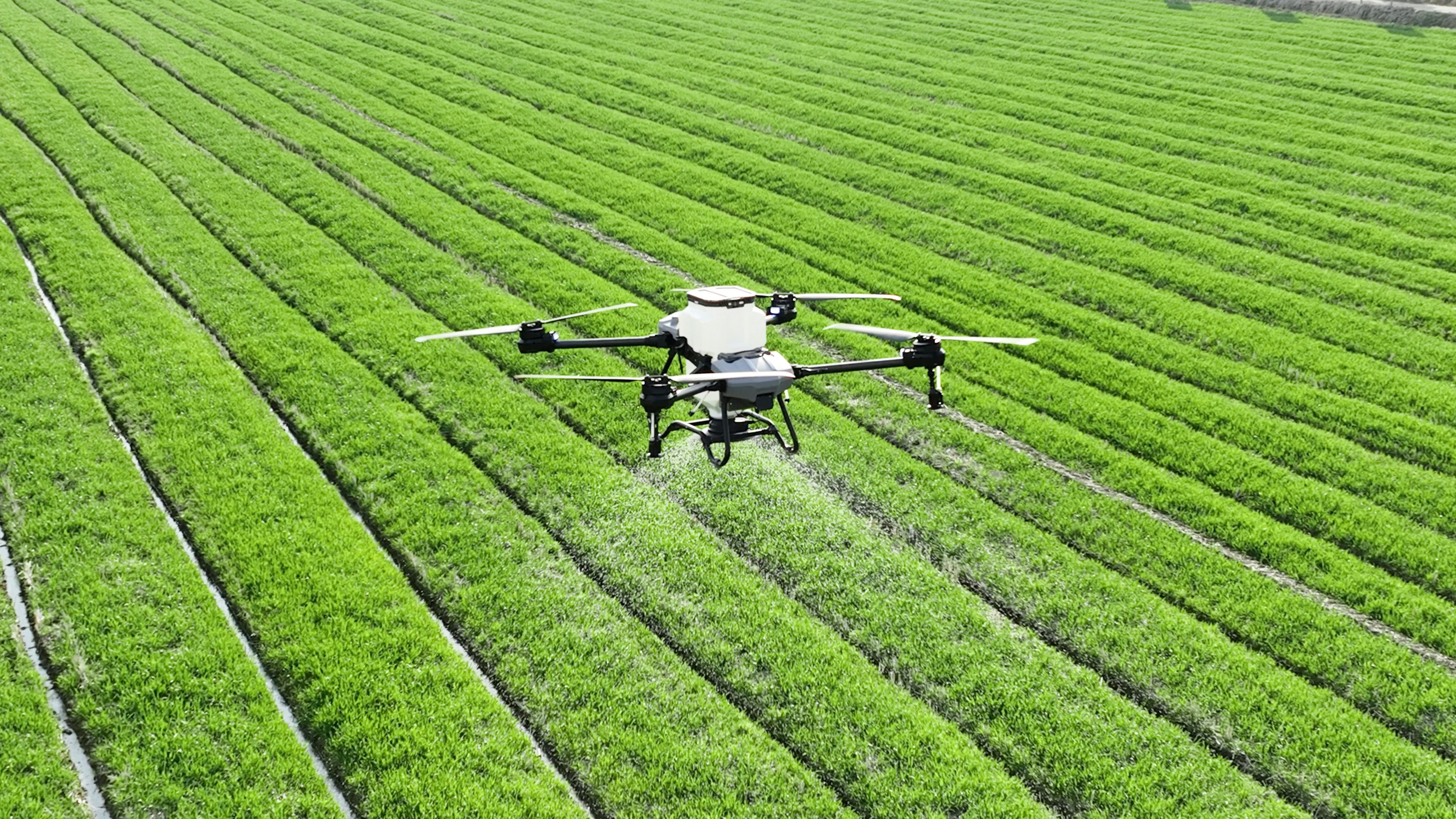
- Mapping, Surveying, & Agriculture: The Foundational Application. The single most predominant application method for commercial drones today is mapping and surveying, which forms the bedrock of use cases in construction, mining, and agriculture (Research and Markets, 2026). In agriculture, drones have moved beyond trials to full commercial maturity, with over 30% of large farms using them for operational tasks. Here, AI is primarily deployed for process improvement—enabling a data-centric farming model that links drone-captured multispectral imagery to automated agronomic decisions (IDTechEx, 2026).
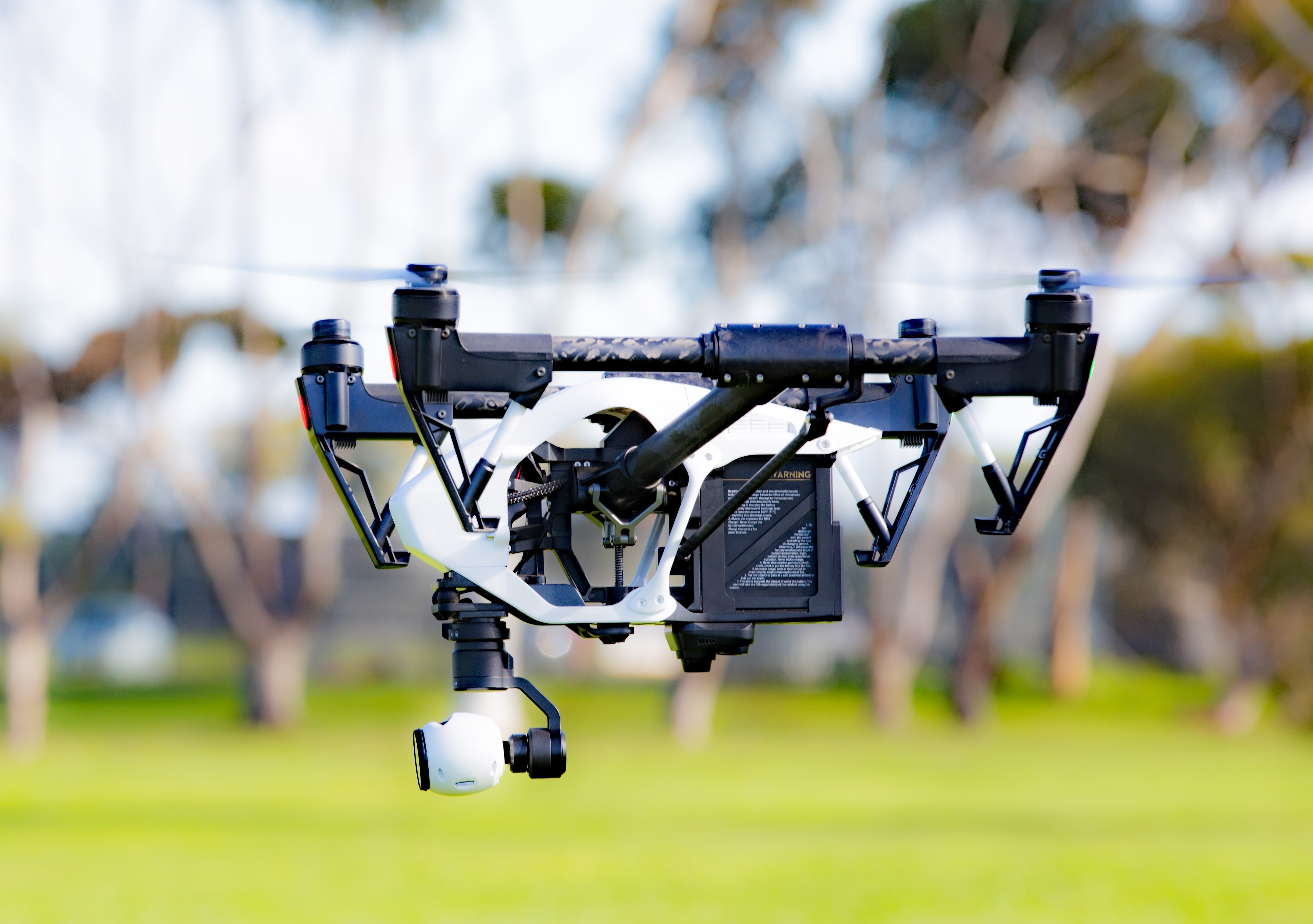
© 2026 EFT Electronic Technology Co., Ltd. - Inspection & Maintenance: The Dominant Vertical. The energy sector currently dominates as the leading vertical for commercial drone adoption (Research and Markets, 2026). For inspecting wind turbines, powerlines, and pipelines, drones offer massive cost reductions and safety improvements over hazardous manual work. This segment, projected to surpass agriculture as the leading source of commercial revenue by 2030, is a hotbed for AI innovation, with automated workflows, drone-in-a-box systems, and AI-powered defect detection becoming the new standard (IDTechEx, 2026).
© Creativecommonsstockphotos | Dreamstime.com (ID: 85217104)
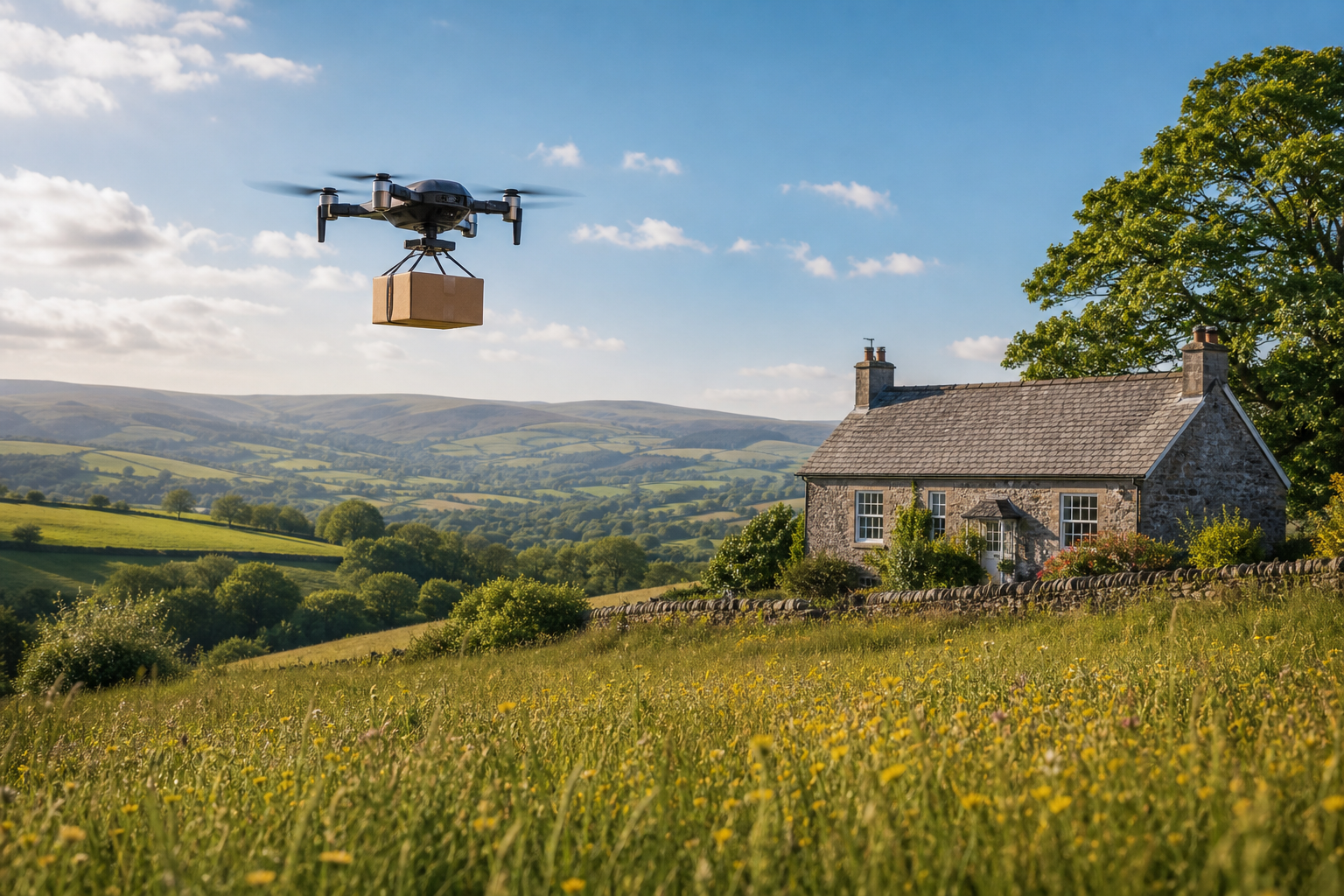
- Cargo & Logistics: The High-Growth Frontier. The highest growth is predicted for applications in cargo, courier services, and intralogistics (Research and Markets, 2026). Despite facing significant regulatory hurdles around Beyond Visual Line of Sight (BVLOS) operations, companies like Zipline, Wing, and Manna are now proving that viable unit economics exist for drone delivery. The future expansion of this segment is directly tied to advancements in Unmanned Traffic Management (UTM) and autonomous flight capabilities.
Source: JPENG
- The manufacturer who built the drone?
- The developer who trained the AI model?
- The operator who deployed the system?
An Unwritten Industry, A New Investment Thesis
The value is not in creating the most powerful AI, but in creating the most governable AI.
The Strategic Option: Defining the New "Product"
- Option A: Selling a "Caged" AI. In this model, a company provides powerful AI but constrains its autonomy within rigid operational parameters and remote human oversight. It's a more advanced tool, but it is still fundamentally a tool. This path minimizes liability but also caps the potential value of true autonomy.
- Option B: Selling "Governed Autonomy." This is the bolder path. Here, the company's core product is not the AI agent itself, but the auditable, insurable, and legally-defensible governance framework that envelops it. The product is a certified system of ethical rules, decision-logging, and risk management that allows a client to deploy an autonomous agent with confidence.
This second option is the true "raise" in value. You are no longer selling hardware (Ownership Stage) or compliance (Security Stage). You are selling a solution to the most complex challenge of the 21st century: how to safely grant machines agency in the real world. The companies that define this new form of ownership and create the products to manage it will not just participate in the future of the drone industry; they will lead it.
 Source: JPENG
The drones case provides a practical demonstration of how innovation must be capitalised on its own terms. This framework paves the way for other innovations, which consistently encounter the full spectrum of development friction—from flow states to structural conflicts in mindset. The Options Stage helps prototype capitalisation pathways and deliver a holistic case. Moving beyond selling products or services, the ultimate value proposition becomes selling the very architecture of a mature, regulated, and AI-enabled industry. This reality shapes the ultimate "raise" in value. The most strategic asset a company can develop is not a piece of hardware or even a proprietary AI model, but a deep, institutional mastery of the framework itself.
The real case is about The Zipline Precedent: A Case Study in "Leveling Up" a Nation
The Business Model of the Future: Framework-as-a-Service
- The Challenge: This is not a scalable software model. Each new country requires deep "contextual intelligence"—a profound understanding of local politics, culture, and needs. It is capital-intensive and demands long-term partnerships, not transactional sales.
- The Prize: The company that successfully exports its framework becomes the de facto standard-setter for that nation's drone industry. It establishes an immensely powerful and durable competitive moat, locking in long-term, national-scale contracts and positioning itself as an indispensable partner in economic development.
Sources & Further Reading
I. Regulatory & Standards Documents
[1] European Commission. (2019). Commission Delegated Regulation (EU) 2019/945 of 12 March 2019 on unmanned aircraft systems and on operators of unmanned aircraft systems from third countries. Official Journal of the European Union, L 152/1.
[2] European Commission. (2019). Commission Implementing Regulation (EU) 2019/947 of 24 May 2019 on the rules and procedures for the operation of unmanned aircraft. Official Journal of the European Union, L 151/1.
[3] European Union Aviation Safety Agency (EASA). (2026). Understanding European Drone Regulations. Retrieved from EASA official website.
[4] International Organization for Standardization (ISO). (2019). ISO 21384-3:2019 — Unmanned aircraft systems — Part 3: Operational procedures.
Note: This standard has been superseded. For current compliance, refer to the latest edition.
[5] UK Civil Aviation Authority. (2026). UK Regulatory Framework for Drones and Other Unmanned Aircraft (CAP 2229).
II. Industry Analysis & Reports
[6] Castellano, F. (2025, August 30). The Drone Market and Industry Trends. Toptal.
[7] Cohn, P., Green, A., Langstaff, M., & Roller, M. (2017, December 5). Commercial Drones Are Here: The Future of Unmanned Aerial Systems. McKinsey & Company.
[8] Fu, S., et al. (2026, June 11). Drones Market 2026–2036: Technologies, Markets, and Opportunities. Edge AI and Vision Alliance. (Reprinted with permission of IDTechEx).
[9] Research and Markets. (2026, May 20). Global Drones Market Report 2026–2036: Emerging Application Insights and 155 Detailed Company Profiles with Competitive and Strategic Assessments.
III. Academic & Managerial Articles
[10] Gibbens, D. (2017, May 22). Grounded: How to Integrate Ethics into Your Drone Strategy. Harvard Business Review. (Reprint H03MYJ).
[11] Kenny, G., Oosthuizen, K., & Pogrebna, G. (2022, November 28). AI and IT Teams Often Clash. But They Don’t Have To. Harvard Business Review.
[12] Khanna, T. (2018, July-August). When Technology Gets Ahead of Society. Harvard Business Review.
[13] Power, E. M., & Trope, R. L. (2005). Acting responsibly with geospatial data. IEEE Security & Privacy Magazine, 3(6), 77-80.
[14] Sucher, S. J. (2023). Embrace AI Without Damaging Trust: Lessons from the “Financial Times”. HBR Executive Masterclass. Harvard Business Publishing.
[15] Khanna, T., & Gonzalez, G. (2021). Zipline: The World’s Largest Drone Delivery Network (HBS Case No. 9-721-366). Boston, MA: Harvard Business School Publishing.
Research and strategic frameworks supported by The Strategy Lab (Harvard Business Publishing).