
By Seth Peng, Founder, JPENG 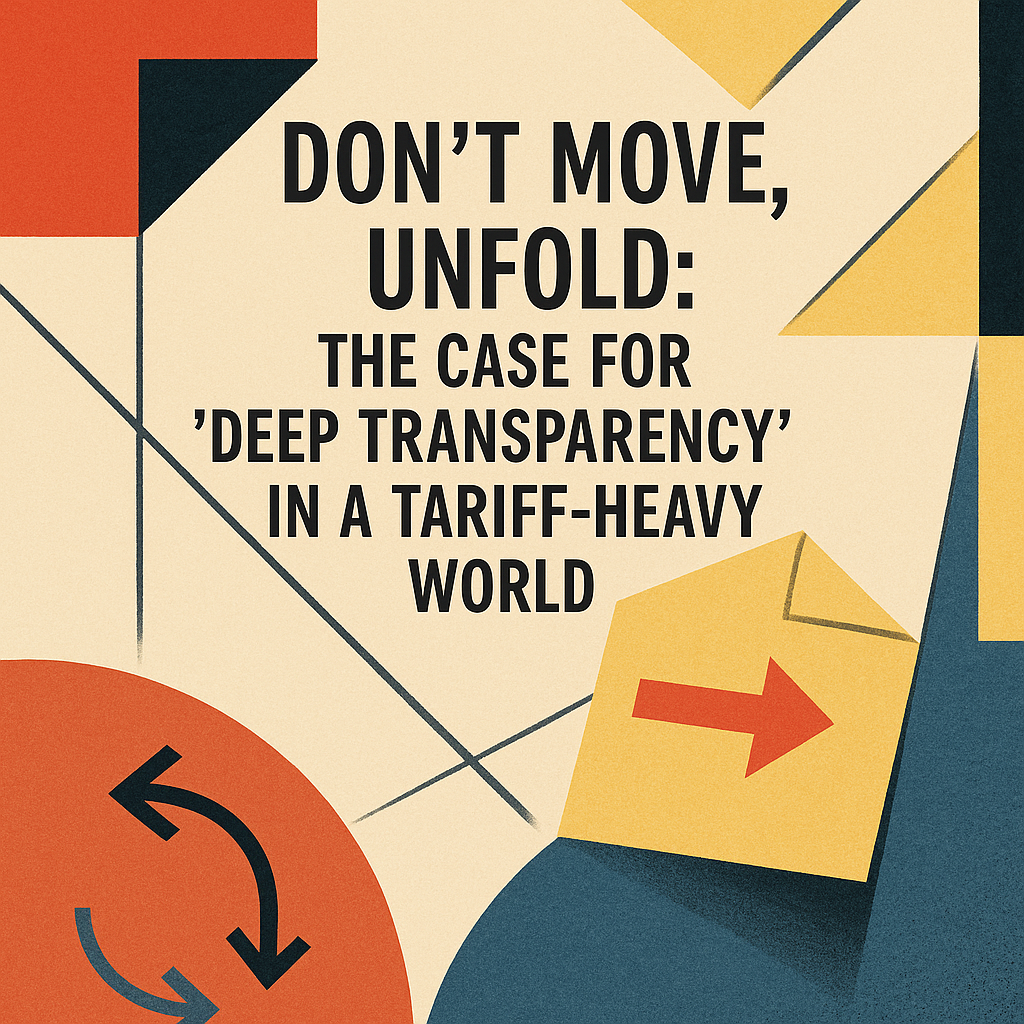
Executive Summary
In the wake of the 2026 tariff landscape, global supply chains are in flux. Data from McKinsey (2025) reveals a mass exodus of manufacturing from established hubs to new regions to evade trade barriers. However, this "Footprint Shift" creates a dangerous "Visibility Paradox": companies are moving assets but losing intelligence. This paper argues that the "Flight" strategy is flawed. Drawing on insights from the World Economic Forum and Harvard Business Review, we propose a counter-intuitive strategy: Deep Transparency. Rather than fleeing risk, smart companies should stay and "unfold" the hidden value of their existing networks, transforming commodity vendors into luxury partners through data-driven bonding.
I. The Context: The Great Reshuffle
Reflecting on the discussions from the World Economic Forum in Davos yesterday, a clear consensus has emerged: the global economy is not just "slowing"—it is "rewiring." Leaders emphasized that in a world defined by tariffs and geopolitical friction, the old model of "blind efficiency" is dead. We have entered an era where provenance is power.
This geopolitical pressure is forcing a massive structural shift. According to McKinsey’s Supply Chain Pulse (Nov 2025), the era of static supply chains is over. "Footprint plans are evolving" rapidly, with 43% of leaders shifting operations to the US and 27% to Southeast Asia to evade tariff walls.
However, moving a factory is not just a logistical challenge; it is an information challenge. The rush to exit established hubs is creating a "herd mentality," where speed is prioritized over stability.
II. The Problem: The Hiding Game
The danger lies in how companies are moving. Many are shifting final assembly to non-tariff countries (like Mexico or Vietnam) specifically to hide their deep-tier connections to tariff-heavy regions. They hope that by moving the "Tier 1" label, they can leverage the advantage of cheap raw materials (Tier 2/3) without paying the penalty.
McKinsey’s "Still Vulnerable" report (Oct 2024) exposes the flaw in this plan: visibility into deep-tier suppliers has dropped to just 30%. Companies are playing a dangerous game of "Regulatory Hide and Seek."
This creates the Visibility Paradox:
- The Move: Companies move factories to non-tariff zones to avoid impact.
- The Hiding: They obscure their Tier 2/3 sources to maintain low costs.
- The Risk: This creates a fragile, opaque network. You are building a supply chain based on evasion, not capability.
III. The Strategic Solution: "Trigger the Unfold"
We need to cure the industry of "Tariff PTSD." The goal isn't to run away or hide; the goal is to distinguish value.
There are two types of factories:
- Commodity Factories: Those that must flee or hide because price is their only value.
- Capable Factories: Those with deep expertise, craftsmanship, and innovation.
The Counter-Intuitive Move: Do not let your "Capable Factories" hide in the shadows. Trigger the Unfold. Instead of treating non-US factories as a liability to be hidden, we must transparently showcase their unique value. By "unfolding" the factory—revealing its machinery, its Tier 2 quality, its skilled labor—we change the conversation from "Tariff Evasion" to "Premium Capability."
As detailed in the seminal Harvard Business Review study "Building Deep Supplier Relationships", the most resilient companies (like Toyota and Honda) historically achieved success not by switching suppliers to save money, but by bonding with partners to fix problems.
Drawing on this strategic principle, JPENG argues that the same logic applies to the 2026 Tariff crisis.
- Don't Hide the Roots: Transparencify the Tier 2/3 network. Show why these materials are superior.
- Create the Bond: Use this transparency to build a "Bonded Relationship." When you know everything about a partner, you trust them.
- The Result: You create a "Luxury" supply chain. The client pays for the capability and the relationship, making the tariff cost irrelevant compared to the value delivered.
IV. The Execution: Making the Network Valuable
This is where the new business relationship begins. At JPENG, we view these "Footprint Plans" not just as a relocation of assets, but as an opportunity to make the network valuable.
We don't just help you find a factory in a non-tariff zone. We help you unfold that factory's true power.
- We use data to prove their capability.
- We use transparency to build the bond.
- We ensure that your international footprint is not a "hidden secret," but a competitive advantage.
Conclusion
In a world of rising friction, the old advantage of obscurity is gone. The only way to cross these new barriers is through value, and value requires visibility.
This pressure is the catalyst for the Unfolded Factory.
By peeling back the layers of the supply chain, we do not just reduce risk; we reveal a premium capability that justifies the bond. We move from a transactional network to a bonded one.
True resilience is no longer about where you hide, but what you reveal.
Stop hiding your footprint. Start unfolding it.
Sources & Further Reading
- McKinsey & Company: Supply Chain Risk Pulse: Tariffs Reshuffle Global Trade Priorities (Nov 2025)
- McKinsey & Company: Supply Chains: Still Vulnerable (Oct 2024)
- Harvard Business Review: Building Deep Supplier Relationships, by Jeffrey K. Liker and Thomas Y. Choi.
- World Economic Forum: Annual Meeting 2026 Insights (Jan 2026)
Research and strategic frameworks supported by The Strategy Lab (Harvard Business Publishing).
About the Author Seth Peng is the Founder of JPENG, an AI-driven procurement ecosystem dedicated to building trust in global trade. He currently serves as the China Desk Head at Dubai Sykon Properties and has previously overseen procurement operations for Fortune Global 500 companies such as CBRE. As a Corporate Executive Member of Harvard Business Review and a guest expert on CCTV, his research focuses on the intersection of transparency and supply chain enhancement.